Showing posts with label Research. Show all posts

Saturday, 22 October 2011

Ed Hopper | His Work + Film Environments Influences

Within this post I looking at the work of ed hooper and his use of light and shadow to enhance our shots on screen. Following on I am going to look to see similar style used in feature films to gain a better idea on how to set up for our shots.

http://fascinatingpeople.files.wordpress.com/2011/04/hopper.jpg
Ed Hopper | Chop Suey (1929)
 This is an old piece of Hoppers work but works excellent for our cafe scene. Granted the window is covered by signs but the way the light hits only a few areas of the restuarant it works great for that dark tone which  I would like to imply into the designs.


This scene is part of the horror sci-fi Legion , however although the diner appears dark and promtes something is about to happen which is dark. This is not necessary exactly what going to happen in our film but displays well the idea I am going for.

http://www.ibiblio.org/wm/paint/auth/hopper/interior/hopper.chair-car.jpg
Ed Hooper | Chair Car
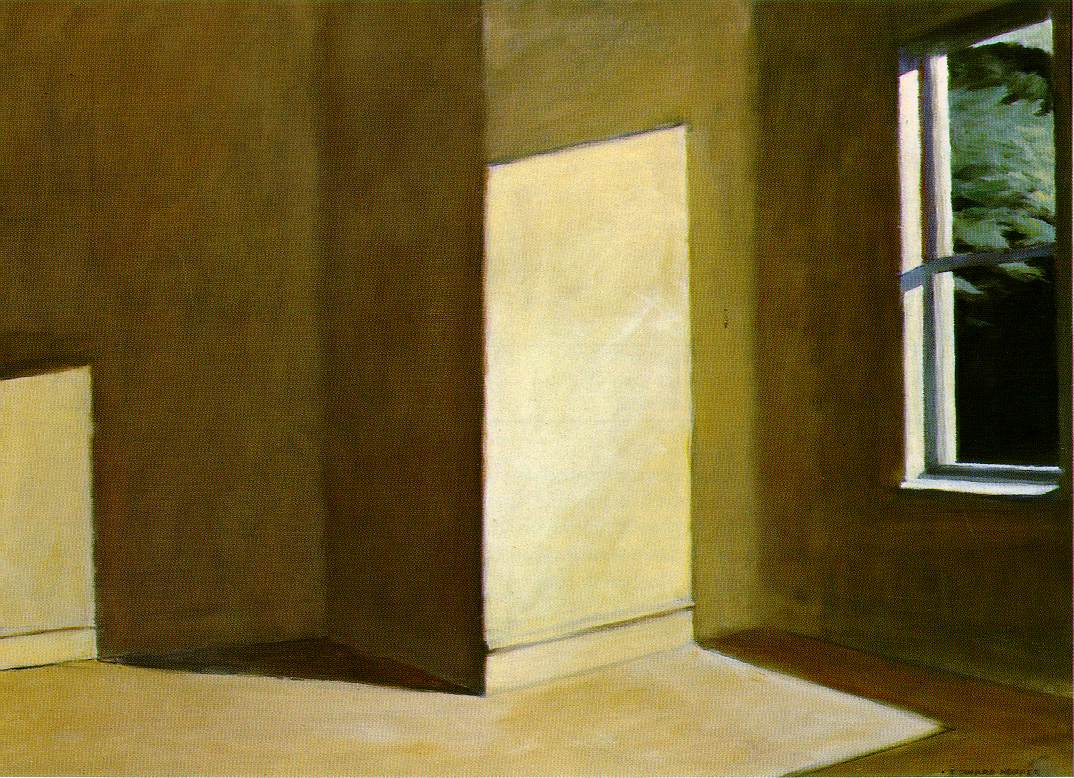
http://www.ibiblio.org/wm/paint/auth/hopper/interior/hopper.sun-empty-room.jpg
Ed Hooper | Sun In A Empty Room


Although these images aren't in a cafe is ineteresting due to the light shining in. Both picture show a dark room which is slightly lightened by the window light. It way I want the cafe to look.


http://desktopia.net/wp-content/uploads/walls/thumbs/Dark-Street-575x359.jpg


I found this shot I found ideal in some ways for the street scene I like the idea that the street is completely dark and this leaves the character almost as silhouette. Perfect to create a dark tone for the night scene. Plus keeping with the Film Noir tone


This works well once again,The lights give minimal light to the street giving it a coldker twist tone. In essence applying a darker twist. 
William Friedkin | The Exorcist
A movie influence is no doubt the exocist poster which shows a light shining down on a shadow figure. It is quite affective but I am divided by it being to sinister for our trailer or good use of shadow to play on our dark motive.


Monday, 17 October 2011

The Gang and The Initiate | Design Process

Fig 1 | The Body Shape
The body shape is vital to my idea behind the gang memeber.  I looked at current design of gangster alongside the triangle shapes of classic evil characters. Moreover I looked for a skinny body shapes to help me portray The Initiate as a malnourished hard up gangster from the bottom of  Los Feliz.


For the fashion style it was easy to go for the mordern day classic gangster look. However when approaching photos of the Crips during 1969 it appeared that it could mixed in with the classic Zoot suit of the 1920's plus the Fadora.

Saturday, 1 October 2011

Week 1+ Research

Synopsis

Sorry for the lateness of this document guys. It been a real issue to scribd. The imges don't want to show. I'll send you a copy of my findings and research if you want just let me know.

Friday, 23 September 2011

Some notes you may find useful...


I've begun some research into postmodernism in film, and thought you might find these notes useful. We are essentially creating a pastiche, representing parts of the past out of context, with a history/future that represents our purpose.

Postmodern Hollywood
What’s new in film and why it makes us feel so strange.
M. Keith Booker, 2007
United States of America: Praeger Publishers

Opening Notes

Booker begins by establishing the elusive nature of Postmodernism; stating that as a “historical and cultural phenomenom” it often runs somewhat “counter to the dictates of what has come to be regarded as “common sense,”… difficult for the ordinary person to grasp”. But he goes on to stress the importance of understanding, pointing out postmodernism’s “impact on virtually every area of contemporary cultural production”. Being still quite vague in my understanding of postmodernism, I hope to discern its relevance and consequences through this book. The briefing Phil gave on Wednesday piqued my curiosity and I’m keen to get to grips with this, even if it seems like grasping at smoke.

The author’s promise to reference contemporary and popular films is encouraging, and his initial analysis of David Lynch’s Blue Velvet (1986) is certainly interesting. He states the importance of understanding that Lynch’s intentions are not to portray reality, but rather “other representations of reality”. Its ambiguous time period, “removed from history”, allows it to exist as more of an “idea than as a reality,” becoming a vehicle for thought and message than true representation. While its inspirations are clearly drawn from the 1950s, the “logic of them film seems specifically meant to undermine the kinds of idealized visions of small-town, nuclear family life”.

Then, Booker goes on to state this as a defining feature of Postmodern art, that “pastiche”, a “cannibalization of all the styles of the past” that undermines past values, portraying them merely as images, “spectacles”. As Phil did, Booker brings up the schizophrenic nature of Postmodernism, that the “loss of individual temporal continuity… contributes to a larger loss of any sense of historical continuity…experience of the pass [becomes] irrelevant”. Its fractal natures leads to the confusion of “ontological levels and boundaries,” a questioning of existence and its logic.

How does Booker’s introduction leave me then? I have slightly better understanding of what postmodernism actually means in terms of noticing it and it applicability. I also begin to perceive the importance of striving to understand and digest it, and the uses the knowledge has. I’m keen to explore its fractious nature, and fully comprehend the use of pastiche and historical in-continuity. It tantalizing and I’m looking forward to exploring it more…